Neuroscience Research Day 2024
The 2024 Buffalo Neuroscience Research Day was dedicated to the memory of the preeminent M. Laura Feltri, MD, who passed away in December 2023. The event featured a host of presentations by Dr. Feltri’s colleagues and trainees, along with UB faculty and student presenters.

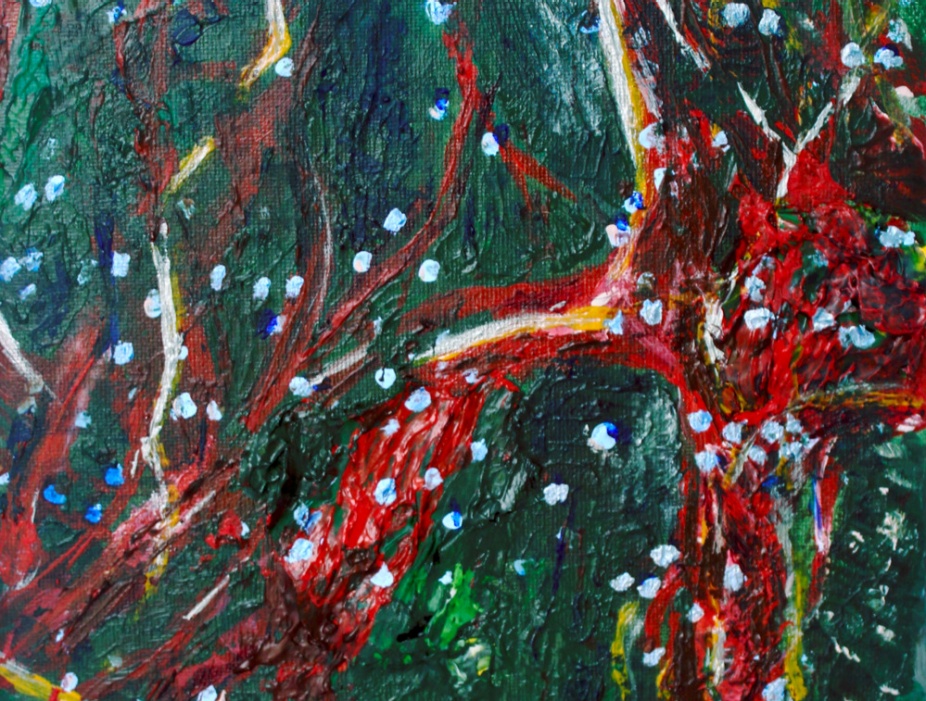
Painting by Camilla Wrabetz, inspired by Dr. Feltri's lab images.
Celebrating Her Legacy
A widely respected scholar and a member of the Jacobs School of Medicine and Biomedical Sciences faculty, she was a SUNY Distinguished Professor of biochemistry and neurology in the Jacobs School and director of UB’s Institute for Myelin and Glia Exploration.
Her research focused on multiple sclerosis; Charcot-Marie-Tooth disease, which affects the peripheral nerves; and Krabbe leukodystrophy, a rare, fatal neurological disease that afflicts newborns.”
Feltri was an internationally renowned pioneer in the study and treatment of myelin diseases in the nervous system. She made numerous seminal discoveries in her field, including developing the first mutagenesis tool for studying the development of Schwann cells, which generate myelin, and the signals that regulate myelination.


Schedule


The conference was held Thursday, September 26, 2024 in downtown Buffalo at the Jacobs School of Medicine and Biomedical Sciences (955 Main St, Buffalo, NY 14203).
Thursday, September 26, 2024
| Time | Event | Location |
|---|---|---|
| 9–9:30 a.m. | Check-in and Breakfast | 2nd Floor Atrium |
| 9:30–10 a.m. | Opening Remarks/Reflections Allison Brashear, MD, MBA
Mark O'Brian, PhD
Maureen Milligan, MS
| 2220A&B Jacobs School |
| 10–11:15 a.m. | Poster Session #1 | 2nd Floor Atrium |
| 11:20 a.m–12:50 p.m. | Invited Speakers: Michael Weaver, MD, PhD | 2220A&B Jacobs School |
| 1 p.m.–2:30 p.m. | Lunch | 2nd Floor Atrium |
| 2:30 p.m.–3:20 p.m. | Invited Speaker: Yannick Poitelon, PhD | 2220A&B Jacobs School |
| 3:30 p.m.–4:20 p.m. | Invited Speaker: Judith B. Grinspan, PhD Two Important Players in Schwann Cell and Oligodendrocyte Differentiation | 2220A&B Jacobs School |
| 4:30 p.m.–5:45 p.m. | Poster Session #2 | 2nd floor Atrium |
| 5:45 p.m.–6:45 p.m. | Dinner | 2nd floor Atrium |
| 6:55 p.m.–7:45 p.m. | Keynote Speaker: Kelly Monk, PhD Molecular and Genetic Dissection of Myelinating Glial Cell Biology | 2220A&B Jacobs School |
| 7:45 p.m.–8 p.m. | Meeting Close Awards Presentation | 2220A&B Jacobs School |
Kelly Monk, PhD


Dr. Kelly Monk is a Professor and co-director of the Vollum Institute. After earning her B.S. degree in Biochemistry from Elmira College in 2001, Dr. Monk pursued doctoral studies at the University of Cincinnati under the mentorship of Nancy Ratner and was awarded her Ph.D. in Cell Biology in 2006. She did postdoctoral training in the lab of William Talbot at Stanford University School of Medicine. In 2011, she was appointed as an assistant professor in the Department of Developmental Biology at Washington University School of Medicine in St. Louis, and was promoted to associate professor with tenure in 2016. Monk joined the Vollum Institute as Professor and co-director in 2017, and she served as director of the Vollum/OHSU Neuroscience Graduate Program from 2018-2023.
The long-term goal of Dr. Monk's research is to understand the genetic, cellular, and molecular mechanisms that govern glial cell biology and to dissect how neuron-glial and glial-glial interactions contribute to nervous system development and function. In particular, her lab studies myelinating glia — the subset of glia in both the central and peripheral nervous systems that generate myelin. Dr. Monk always considered Dr. Laura Feltri to be her cool big sister in science and looked up to her both personally and professionally. Drs. Monk and Feltri collaborated on a number of studies related to Schwann cell biology, and Dr. Monk is a better person and scientist for these interactions.
Judith B. Grinspan, PhD


Dr. Grinspan is Co-Leader, Developmental Biology Research Affinity Group at Children's Hospital of Philadelphia, and Research Professor of Neurology at Perelman School of Medicine at the University of Pennsylvania.
The goal of Dr. Grinspan’s research centers on identifying factors in the central nervous system that inhibit the development of mature oligodendrocytes both during development and in diseases. Along with her colleagues, she has observed the role that oxidative stress and inflammation have on impeding myelination. Consequently, she has identified several families of signaling factors in the central nervous system that are activated by these processes and interfere with oligodendrocyte development and myelination, including bone morphogenetic proteins and the Wnt/b-catenin family of signaling factors. More recently, she has characterized mechanisms by which several cellular processes; lysosomal function, lipid synthesis, and the integrated stress response, inhibit oligodendrocyte maturation and myelination.
In 1990, Dr. Grinspan, then a newly minted Assistant Professor at the Children’s Hospital of Philadelphia and the University of Pennsylvania, started working with then postdoc Dr. Feltri when Dr. Feltri first came to the United States and began her research career at Penn. They became great friends and close colleagues, which they remained for the next 33 years until Dr. Feltri’s untimely death.


Dr. Nunes is currently a postdoctoral fellow in the lab of Dr. Ethan Hughes at the University of Colorado - Anschutz Medical Campus. He is currently investigating how demyelination affects neuronal functional and behavior. Dr. Nunes holds a PhD degree in Biochemistry from UB, where he trained with Dr. Laura Feltri, investigating the role of mitochondrial proteins in myelination and myelin maintenance. He holds a BSc degree in Biomedical Sciences and a Master's degree in Neuroscience, both from the Federal University of Rio Grande do Sul (UFRGS) in Brazil.


Dr. Poitelon is Associate Professor of Neuroscience and Experimental Therapeutics and co-leader of the Myelin Laboratory at the Albany Medical College.
He was trained by Dr. Laura Feltri. His studies have contributed to the understanding of axon-glia interaction, myelinating cells mechanobiology and metabolism, and provided insights to Charcot-Marie-Tooth disease, a group of inherited neuromuscular disorders affecting the peripheral nervous system. Dr. Poitelon’s current research focuses on mechanisms underlying myelin formation in health and disease.
Michael Weaver, MD, PhD


Dr. Weaver is a clinical and research postdoctoral fellow with Dr. Sangita Patel in UB's Department of Ophthalmology, where his time is divided between seeing patients and conducting lab research. His current focus is developing an in vitro model of Fuch's endothelial corneal dystrophy (FECD) and investigating the role of pathological extracellular matrix (ECM) accumulation in FECD disease progression.
Dr. Weaver completed his MD-PhD degree in Neuroscience from UB in 2024, after conducting his dissertation research in the lab of Dr. Laura Feltri, where part of his project focused on laminin receptor expression in Schwann cells. Laminin is a major part of the ECM in Schwann cell basement membranes. Therefore, Dr. Weaver's current work with Dr. Patel continues his general focus on ECM biology.