Margaret L. Wendt Foundation Clinical Competency Center

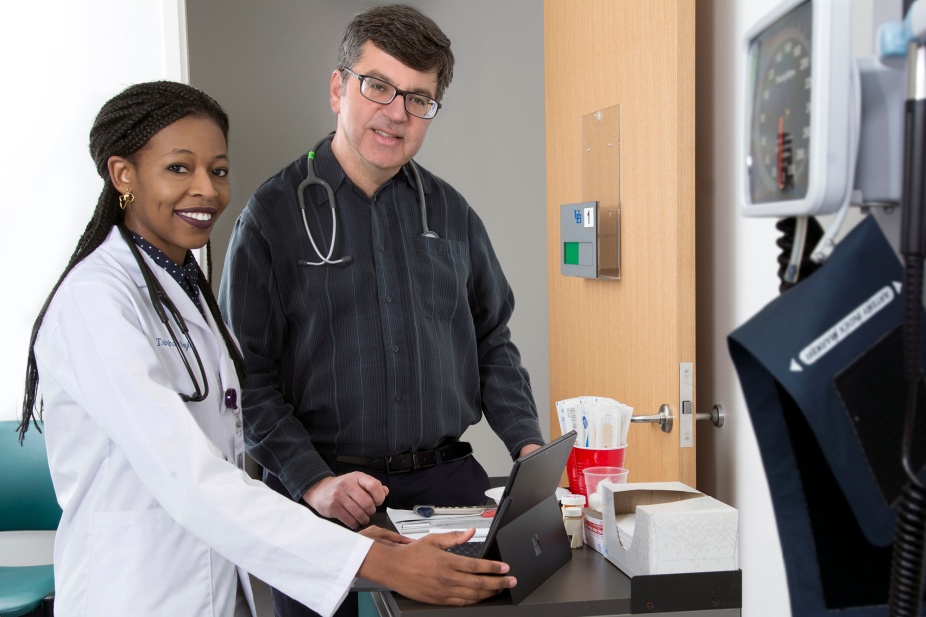
Medical students learn patient examination procedures with a standardized patient. Supervising is Andrew B. Symons, MD, clinical professor and vice chair for medical student education in the Department of Family Medicine.
Our dedicated clinical competency center prepares medical students for national competency exams with real-world interactive scenarios featuring standardized patients.
The Margaret L. Wendt Foundation Clinical Competency Center
Our dedicated clinical competency center prepares medical students for national competency exams with real-world interactive scenarios featuring role players as patients. The center functions as a workshop for clinical encounters, allowing learners to practice interviewing, examination, counseling, and professional communication with role players before applying these skills in real clinical settings. While the Behling Human Simulation Center emphasizes hands-on and team-based clinical scenarios, the Clinical Competency Center allows learners to focus on the interpersonal and cognitive aspects of patient care.
Intensive Clinical Preparation
In this center’s 18 exam rooms, our medical students practice taking patient histories, performing physical exams, communicating disease management and treatment options, and discussing the diagnosis of terminal illnesses. To build their interpersonal and examination skills, medical students work with role players—individuals trained to simulate real patients with specific conditions. This also prepares them to pass the United States Medical Licensing Exam (USMLE).
“The clinical competency training at UB is one of the gems of the school,” says Troy Pittman, MD ’06. “Staff in the Clinical Competency Center put together an experience that mimics the actual exam closely.”
Learning in the Long Term
Digital audio and video systems in each room transmit live feeds to faculty and staff in monitoring rooms. Faculty and staff can operate the cameras to change the angle and zoom, and record each session. Even the otoscopes have cameras embedded in them to capture video of what students see in the ear, nose and throat as they perform an exam.
This sophisticated, comprehensive learning system helps students immerse themselves in the clinical role. Later, they review their performance with feedback from faculty, cultivating self-reflective abilities that not only give them an edge during medical school but support continued improvement in their communication skills in the long term.
Real-World Cases
Faculty write case scenarios to develop and test students’ professional skills. Recording these standardized interactions generates a consistent measure of students’ abilities and improvement over time. Many of our departments, including surgery, family medicine, medicine, orthopaedics and psychiatry, train residents as well as MD students in the Clinical Competency Center.
Practice, Feedback, and Growth
Learners engage with trained role players in realistic outpatient exam rooms and receive structured feedback focused on observable behaviors and communication skills. Audiovisual review supports the encounters, providing learners with the ability to reflect on their performance and implement specific improvements, much like high-level athletes, such as professional football players.
The emphasis is on growth and refinement rather than high-stakes evaluation, helping learners build confidence and competence over time.
A Realistic Clinical Environment
The Clinical Competency Center is designed to look and feel like a real outpatient setting, equipped with 18 exam rooms. The Center has been used for filming due to its realism and minimal privacy or HIPAA constraints associated with live patient care.
The space offers an authentic clinical atmosphere while maintaining complete control over access, scheduling, and confidentiality.
How to Request Services
Please submit a simulation request (coming soon) with information that will assist us with scheduling and planning the resources necessary for your event.
Please Note
Simulation requests and materials must be provided no later than six weeks prior to your requested session date.
Location
The Margaret L. Wendt Foundation Clinical Competency Center
Jacobs School of Medicine and Biomedical Sciences
955 Main Street
6th Floor, Suite 6101
Buffalo, NY 14203-1121
Phone: 716-829-3455
Contact Information
Clinical and Administrative Director

UBMD Emergency Medicine 77 Goodell Street Suite 340 Buffalo, NY 14203
Phone: 716-645-9700
Email: dmirsch@buffalo.edu
Educator and Administrator

Sherrie Kern
Educator and Administrator
Clinical Competency Center
955 Main Street, Suite 6101, Room A, Buffalo, NY 14203-1121
Phone: Office: 716-829-3455
Email: sharonke@buffalo.edu
Educator
Phil Wade
Educator
Behling Simulation Center / Clinical Competency Center
955 Main Street, Suite 6101, Buffalo NY 14203-1121
Email: pdwade@buffalo.edu
Staff Assistant
Alex Garcia
Staff Assistant
Behling Simulation Center / Clinical Competency Center
955 Main Street, Suite 6101, Buffalo NY 14203-1121
Email: alexgarc@buffalo.edu