Curriculum and Requirements

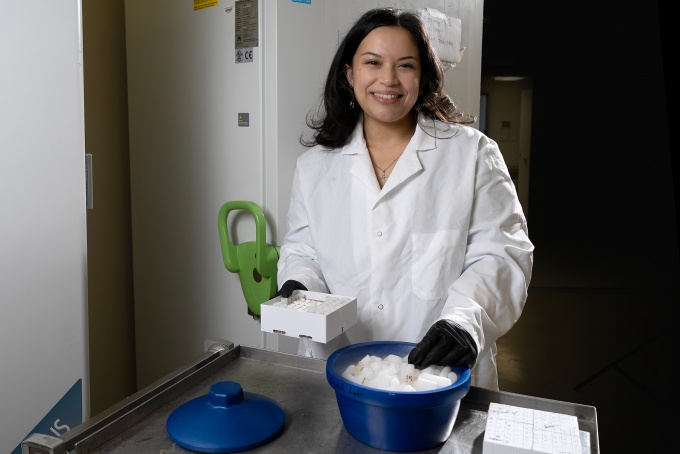
Master’s student Nissa Medwid utilizes a tissue culture hood and minus 80 degrees Celsius freezer for the sterile handling of animal and human cells and the long-term storage of cells and supplies known as "the frozen zoo."
This 30-credit hour program combines interdisciplinary coursework with diverse, hands-on laboratory research.
You will gain the experience and knowledge needed to explore your own research through a required master’s thesis or project. GGB MS students will also participate in our annual GGB Research Day each spring semester. More information about the GGB Curriculum and MS Thesis or Project requirements is available in the GGB MS Handbook.
We strongly recommend that you identify a faculty member whose lab you are interested in before applying to our program.
During first year of the GGB MS program, students will complete their core GGB coursework and begin working on research in their mentor's labs. Accepted students should aim to have a faculty mentor in place at the start of their first semester. In the fall semester, students will work with their faculty mentor to form their MS research advisory committee. In the spring semester, students will present their research proposal to their committee in GGB 607 - Presentation Seminar.
- GGB 502 Essentials of Genetics and Genomics, 3 credits
- BMI 503 Systems, Databases, & Software Development Methods in Biomedical Informatics, 3 credits
- GGB 701 Research, 2 credits
And one of the following:
- BMS 501 Cell Biology I, 4 credits OR
- BCH 503 Biochemical Principles, 4 credits
- GGB/BCH 519 Bioinformatics and Computational Biology, 3 credits
- GGB 701 Research, 1-12 credits
- GGB 607 Presentation Seminar, 1 credit
- GGB Thesis or Project Proposal
- 1 - 2 Electives, 0-6 credits
- Required Elective and Additional Elective/Special Topics Course options are listed below.
During year 2 of the GGB MS program, students will complete their remaining course requirements and continue their research. Final elective course requirements are typically completed in the fall semester. In the spring semester, students will complete, present and submit their final thesis or project in GGB 607 - Presentation Seminar.
- GGB 701 Research, 1-6 credits
- Electives & Special Topics, 0-6 credits
- 1 - 2 Electives, 0-6 credits
- Required Elective and Additional Elective/Special Topics Course options are listed below.
- GGB 607 Presentation Seminar, 1 credit
- GGB MS Thesis Defense or Project Presentation
- GGB 701 Research, 1-6 credits
- Electives and Special Topics, 0-6 credits
Required Elective Courses (Choose 2)
All GGB required elective options are options are listed below. GGB MS students must complete 2 of the following required electives to fulfill their degree requirements.
- GGB/BCH 505 Human and Medical Genetics, 3 credits
- GGB/BCH 512 - Developmental Genomics and Stem Cell Biology, 3 credits
- GGB/MIC/BCH 611 Advanced Microbial Genetics, 2 credits
- BCH 508 Gene Expression, 2 - 3 credits
- BCH/MIC 506 - The Human Microbiome, 2 credits
- BCH/MIC 607 DNA Replication and Repair, 2 credits
- BMS 507 Statistical Computing in Biomedical Sciences, 3 credits
- BIO 550 Human Evolutionary Genomics, 3 credits
- EEH 674 Fundamentals of Genetic Epidemiology, 3 credits
- STA 525 Stats for Bioinformatics, 3 credits
- PHC 509 Pharmacogenomics in the Pharmaceutical Sciences, 2 credits OR PHC 517 Pharmacogenomics, 2 credits
Additional Elective and Special Topic Courses (3 Credits Required)
In addition to the required electives, GGB MS students must also complete 3 credits of special topics or additional electives. Preapproved options are listed below. GGB Students may also elect other GGB courses or 500-600-level courses in computer science, biostatistics, neuroscience, microbiology and biology, with permission from your adviser and the program.
Biochemistry (BCH):
- BCH 507 Protein Structure and Function, 2-3 credits
- BCH 508 Gene Expression, 2 credits
- BCH 515 Developing your Biomedical Professional Brand, 1 credit
- BCH 607 DNA Replication and Repair, 2 credits
Biological Sciences (BIO):
- BIO 526 Human Genetic Diseases
- BIO 550 Human Evolutionary Genomics, 3 credits
- BIO 502 Advanced Cell and Developmental Biology I, 4 credits
- BIO 556 Evolutionary Genetics, 3 credits
Biomedical Sciences (BMS):
- BMS 507 Statistical Computing in Biomedical Sciences
Computer Science and Engineering (CSE):
- CSE 536 Computational Biology, 3 credits
- CSE 601 Data Mining and Bioinformatics, 3 credits
- CSE/BMI 577 Processing of Strings and Sequences
Epidemiology and Environmental Health (EEH):
- EEH 674 Fundamentals of Genetic Epidemiology, 3 credits
Microbiology and Immunology (MIC):
- MIC 512 Fundamentals of Immunology, 2 credits
- MIC 603 Viruses and Cancer, 2 credits
- MIC 607 DNA Replication and Repair, 2 credits
- MIC 627 Molecular Parasitology, 2 credits
Neuroscience (NRS):
- NRS 521 Neuroscience Intro 2, 4 credits
- NRS 524 Quantitative Neuroanatomy, 4 credits
Oral Biology (ORB):
- ORB 510 Saliva and the Oral Microbiome, 2 credits
Physiology (PGY):
- PGY 505 Cell and Membrane Physiology, 4 credits
- PGY 607 Cellular and Molecular Basis of Disease, 3 credits
Pharmaceutical Sciences (PHC):
- PHC 509 Pharmacogenomics in the Pharmaceutical Sciences, 2 credits
- PHC 517 Pharmacogenomics, 2 credits
Pharmacology and Toxicology (PMY):
- PMY 527 Modern Approaches to Drug Discovery, 2 credits
- PMY 627 Target Organ Toxicity, 2 credits
Biostatistics (STA):
- STA 509 Statistical Genomics, 3 credits
- STA 525 Stats for Bioinformatics, 3 credits
- STA 545 Statistical Data Mining, 3 credits
Structural Biology (STB):
- STB 530 Mathematics and Physics Topics for Structural Biologists, 2 credits