Simulators and Equipment

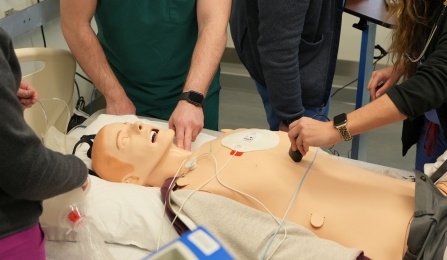
Residents grouped around a bed with a SimMan 3G to perform an ultrasound scan.
The Behling Human Simulation Center uses manikins and task trainers to simulate patients to create high-risk, low-frequency events that we do not wish to subject patient actors to.
On This Page:
High-Fidelity Patient Simulators
High-Fidelity manikins are meant to mimic patient physiology, whether through physical features, such as pulses and chest rise, or through the vitals projected on the patient monitor. These will give real-time feedback to the learner and can be adjusted from the control room.
SimMan Simulators

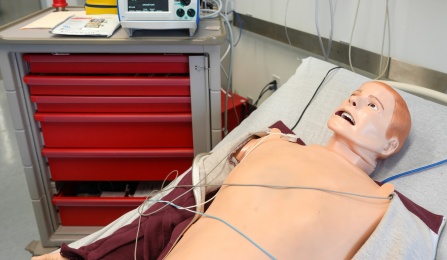
Laerdal's SimMan 3G manikin can simulate an adolescent to elderly patient, and has the following features:
- Pulses
- Chest rise
- Blinking
- Angioedema
- Trismus
- Cervical spine rigidity
- Bilateral tension pneumothorax
- Intraosseous practice sites
- Convulsions
- CPR compression feedback
Please contact us with any questions, as this is not meant to be a comprehensive list of all features.

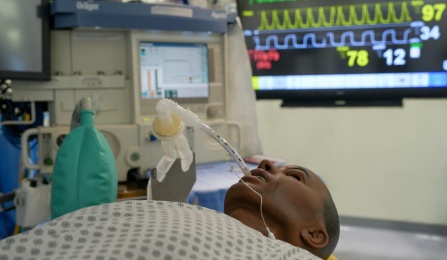
Laerdal's SimMan 3G+ has the same features as SimMan 3G (above) with more realistic skin appearance, better articulated joints, and the capability to interact with the ASL5000 for respiratory waveform simulation (detailed below).
SimJunior

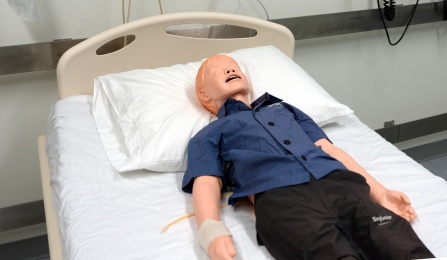
Laerdal's SimJunior can simulate a juvenile between 7-12 years of age. There are pulses.
SimBaby

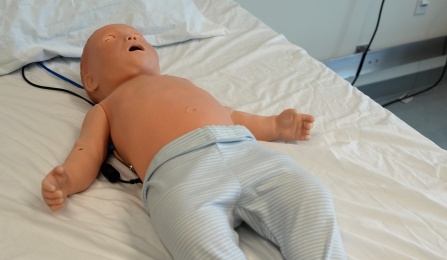
Laerdal's SimBaby simulates a 12 month-old with the following features:
- Blinking
- Chest rise
- Movement and extremity tone
- Capillary refill
- Difficult airway
- CPR compression feedback
Please contact us with any questions, as this is not meant to be a comprehensive list of all features.
SimNewB

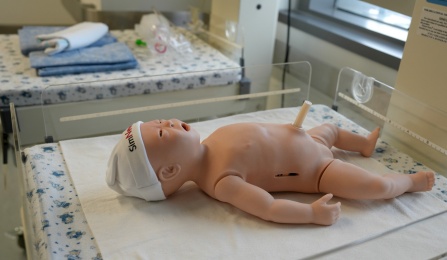
Laerdal's SimNewB simulates a neonate with the following features:
- Chest rise
- Movement and extremity tone
- Difficult airway
- CPR compression feedback
Please contact us with any questions, as this is not meant to be a comprehensive list of all features.
Lucina

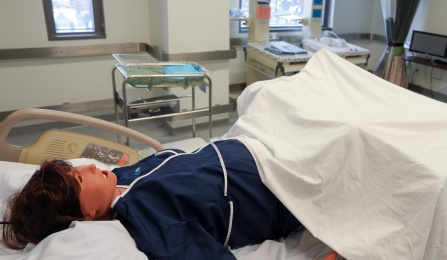
Elevate Healthcare's Lucina labor and delivery simulator focuses on obstetric and women's health. Lucina's scenarios simulate a realistic delivery, postpartum intervention, and complications such as amniotic fluid embolism. Delivery scenarios include a normal delivery, breech birth, and shoulder dystocia simulation. Please reach out with questions about what Lucina can simulate.
Simulator Peripheral Equipment
All of the high-fidelity simulators have the capability of using a patient monitor, and some have the capability of interfacing with other equipment that enhance the learning environment.
Patient Monitor

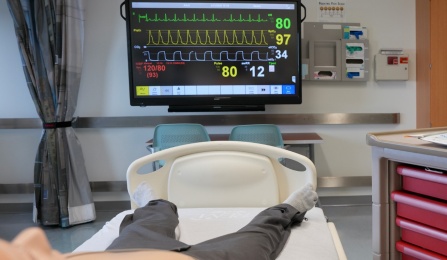
Each of the simulation rooms have a wall-mounted touchscreen that is used to display the patient's real-time vitals. Depending on the simulation scenario, waveforms can be added or removed to display what is appropriate in the intended clinical environment (emergency bay, ICU, operating room, outpatient, etc.) The control room has instantaneous control over the vitals to show the physiological reaction of the patient to the interventions that the learner administers. The monitor can also display radiology images, lab results, and a 12-lead ECG for the learners to interpret.
Laerdal-SonoSim Ultrasound Solution (LSUS)

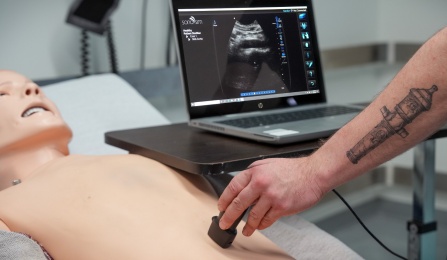
The SimMan 3G simulator has a series of RFID tags located around the body that the LSUS ultrasound probe can scan and display real patient ultrasound scans on an associated laptop. This device can aid in diagnosis with real-time imaging capability.
ASL5000
The ASL5000 is a device that can interact with SimMan 3G+ and SimBaby to display waveforms on an anesthesia machine, or ventilator. Preprogrammed waveforms, such as COPD or ARDS can be activated from the control room to display on the learners' interface in order to aid in simulation realism and immersion.
Stand-Alone Simulators and Task Trainers
These simulators focus on a specific skill and mimic the appropriate patient anatomy for that skill. These do not involve the control room, and are not directly associated with the high-fidelity simulators, though they can be used in conjunction with the high-fidelity simulators to increase the capability of a given case (i.e. bringing a CentraLine Man trainer into the room to have the learners actually perform a central line, where they normally would not be able to on one of the SimMan simulators).
Vimedix

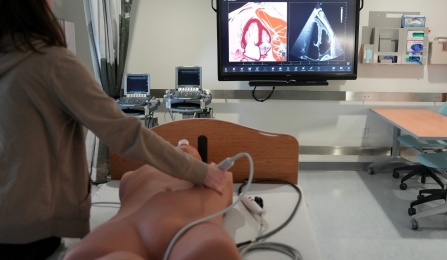
Elevate Healthcare's Vimedix simulator is primarily driven from a laptop in the simulation room, with the options of two different simulators: Bob and Catherine. The learner can choose from different transducer options to scan the simulator and the laptop will display the appropriate ultrasound and/or augmented reality anatomy. The Vimedix simulator is especially useful to display pathological ultrasound images that learners may not normally see during clinical rotations, such as: tamponade, free fluid during FAST exams, or a cleft palate during pregnancy.
Transducer options include:
- Linear
- Curvilinear
- Phased array
- TEE
- Endocavitary
Please contact us with any questions about what can be demonstrated with the Vimedix system.
Airway Task Trainers

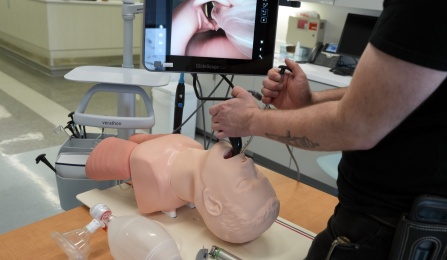
The Behling Human Simulation Center has 18 adult and one pediatric airway management trainers that can be used to practice nasal canula, face mask, and non-rebreather placement, bag-valve-mask usage, supraglottic airway placement, and advanced airway placement.
Venipuncture Trainers and Arterial Line Trainers

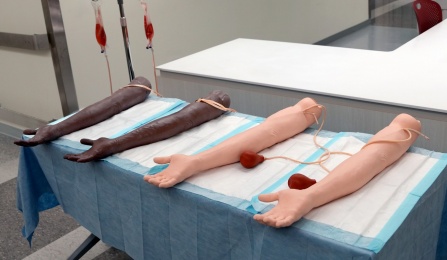
Two of our venipuncture trainers (left) and two of our arterial line trainers (right).
The Behling Human Simulation Center has six venipuncture trainers used for IV placement.
The Behling Human Simulation Center has two arterial line trainers.
Central Line and Femoral Line Trainers

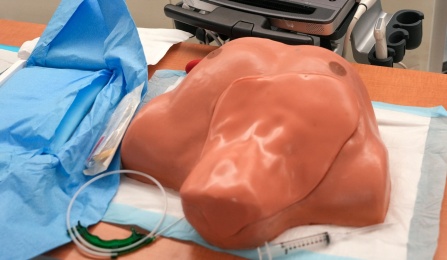

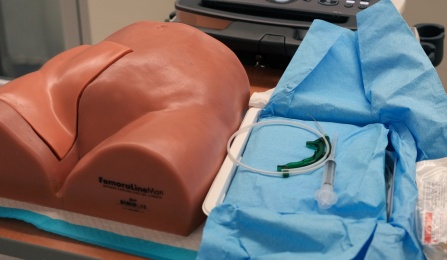
The Behling Human Simulation Center has four CentraLine Man and four FemoraLine Man simulators, which are ultrasound-capable facsimiles of the neck and groin anatomy that a Central Venous Catheter (CVC) may be placed into. These trainers are especially useful to practice needle tracking and become acquainted with the contents of the CVC kits.
Lumbar Puncture Trainers

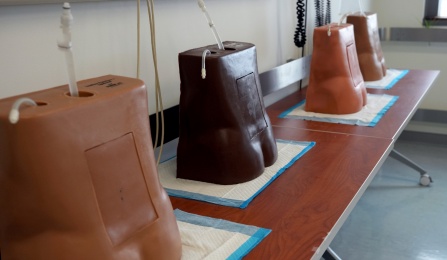
The Behling Human Simulation Center has eight lumbar puncture trainers, useful for practicing the procedure that would collect cerebrospinal fluid for testing.
Lumbar Puncture Trainers

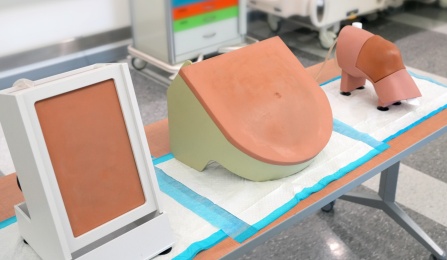
A thoracentesis trainer (left), a paracentesis trainer (middle), and an arthrocentesis trainer (right).
The Behling Human Simulation Center has two arthrocentesis trainers, two paracentesis trainers, and two thoracentesis trainers that are ultrasound capable.
Ultrasound
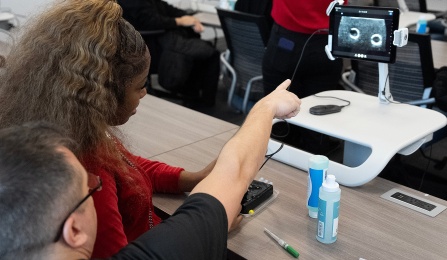
The Behling Human Simulation Center has a number of ultrasound devices to use on the above-listed task trainers.

Please contact us if you do not see a trainer that you may be looking for. We have created suture pads, dermatology biopsy pads and ultrasound trainers in the past.
Behling Human Simulation Center
Jacobs School of Medicine and Biomedical Sciences
955 Main Street
6th Floor, Suite 6230
Buffalo, NY 14203-1121
Phone: 716-829-3455