Our History
Founded in 1846, the Jacobs School of Medicine and Biomedical Sciences is one of the oldest medical schools in the United States.
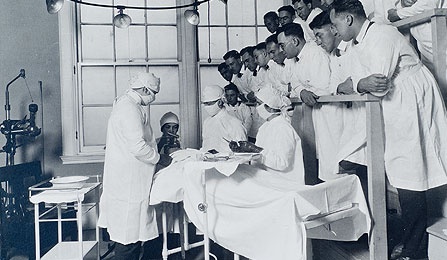

A Grand Rounds session at the Medical School. Source: University Archives
Legendary founders
Our founding faculty are legends in the annals of American medicine:
- James Platt White, a pioneer in obstetrics and gynecology who extended clinical teaching to include the demonstration of live birthing
- Austin Flint, a renowned diagnostician and epidemiologist and president of the American Medical Association
- Frank Hastings Hamilton, a preeminent surgeon who introduced the use of ether as an anesthetic in the Niagara Frontier and who served as the school’s first dean and chair of surgery
Establishment
The school was established when Buffalo was a boomtown on the Erie Canal and the gateway to the West.
Leading citizens—primarily physicians and lawyers—proposed that an institution of higher learning be established, which led to the founding of the private, nonsectarian University of Buffalo.
The Medical School, or Medical Department, as it was called, was the first decanal unit within the university, and 40 years passed before other departments were added.
Medical classes began February 24, 1847, with an enrollment of 66 students.
On the move
The medical school’s first permanent location was next to Buffalo General Hospital in downtown Buffalo.
In 1893, the school relocated to High Street in the city, where it remained until 1953, when it moved to the university’s South Campus.
In 1962, University of Buffalo merged with the State University of New York (SUNY) system. The Medical School then became the School of Medicine, State University of New York at Buffalo.
In 1987, the medical school’s name was changed to the School of Medicine and Biomedical Sciences in recognition of the basic sciences underpinning medical knowledge.
In 2015, it become known as the Jacobs School of Medicine and Biomedical Sciences — the first school naming in UB history — in recognition of the Jeremy M. Jacobs family’s longstanding philanthropy and service to UB.
In 2017, the school relocated to its home on the Buffalo Niagara Medical Campus, a 628,000-square-foot building at 955 Main St., just steps from where it was located from 1893 to 1953.
A model system
Throughout its history, the university has not owned or operated a teaching hospital, but instead has instructed students in affiliated hospitals throughout the city.
A unique consortium of teaching hospitals was created in 1983 - the Graduate Medical Dental Education Consortium of Buffalo. At the time, it served as a national model for graduate medical education. Today, the Jacobs School of Medicine and Biomedical Sciences continues to offer students, residents and fellows a wide range of clinical experiences and training opportunities at Western New York hospitals and hospital systems.
Landmark achievements
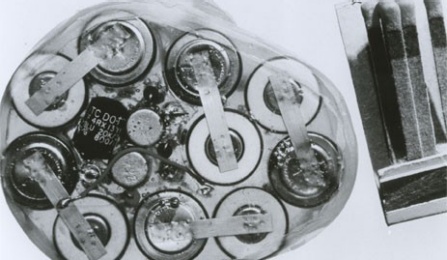

Invented at UB: the first successful implantable pacemaker.
Over the last century and a half, our faculty have made significant contributions to the advancement of the basic sciences and clinical care.
Notable among these accomplishments:
Paving the way for future physicians
At the start of the 21st century, our school’s clinical and basic-science strengths are evident in cardiovascular and neurologic disorders, ion-channel physiology and biophysics, retinal and cardiac electrophysiology, cellular and molecular signaling, computational biophysics and exercise physiology. Our research centers enjoy national reputations.


