NICE Seminar
The Neighborhood Network of Integrated Care (NICE) initiative of the Division of Hematology/Oncology represents a groundbreaking community-academic partnership.
NICE directly engages the community by disseminating guidelines and recommendations from the Centers for Disease Control and Prevention, the American Cancer Society and the National Cancer Institute through community seminars, community-based partners and learning materials created by University at Buffalo students about health care screening, including cancer care information.
Director


Satheesh kumar Poolakkad Sankaran, DDS, MDS, MSc, MMSc
Research Scientist
Medicine
Associate Director

Clinical and Translational Research Center 875 Ellicott Street, Room 6085 Buffalo, NY 14203
Phone: 716-881-8918
Email: rpili@buffalo.edu
Administrative Assistant
Cedrick Ball
Administrative Staff Assistant
Medicine
Phone: 716-878-3317
Email: cedrick@buffalo.edu

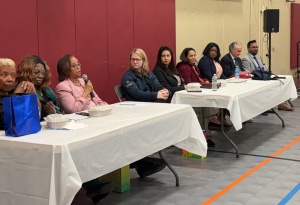
Launched in association with the Health Ministries of St. John Baptist Church and Gethsemane Missionary Baptist Church, it embodies the principle of “Bringing Education to the Community.” An inaugural event, “Let’s Talk Cancer in the African American Community: What Does Cancer Look Like?” held on Saturday, Nov. 23, 2024, at the Reverend Dr. Bennett W. Smith Sr. Family Life Center (833 Michigan Ave., Buffalo, NY 14203), drew community members for presentations by Drs. Poolakkad Sankaran and Roberto Pili on cancer screening, survivorship care, nutrition’s role in cancer prevention, and on-site breast screenings by physicians. Lunch was served (Sponsored by Community Health Speaks), and registration underscored community commitment.
Building on this momentum, NICE has expanded strategically into trusted community spaces: neighborhood barbershops; African American East Buffalo high schools including a landmark event at Leonardo da Vinci High School on June 12, 2025; collaborative examination of Social Determinants of Health (SDOH) at Buffalo General Medical Center (part of Kaleida Health); and a forthcoming multi-church NICE initiative at 15 Pine Street on June 6.
These extensions amplify reach, tailor interventions to specific demographics (men and women, youth, families), and integrate prevention, education and equity. By May 2026, these efforts have positioned NICE as a model for community-engaged cancer control, fostering trust, reducing disparities, and promoting holistic well-being. This report details each expansion, drawing on program data, local context, and evidence-based practices.
“Talking Cancer in the African American Community – Increasing Cancer Screening in Erie County”
Sponsored by community outreach, NICE
Division of Hematology Oncology
Department of Medicine
Jacobs School of Medicine and Biomedical Sciences, UB
Hosted by: First Shiloh Baptist 15 Pine Street, Buffalo, NY 14204
Registration is required by May 30, 2026.
Call Dr. Quick at (716) 863-7049 or email firstshilohmail@gmail.com.
- Date: June 6, 2026
- Time: 11 a.m.–3 p.m.
- Location: First Shiloh Baptist, 15 Pine Street, Buffalo, NY 14204
Lunch provided

Presented by Drs. Poolakkad-Sankaran and Pili:
- interactive community-level role-play on communication barrier
- discussed misconceptions about cancer
- conversations regarding health care access and transportation issues among African Americans
- the importance of cancer nutrition
Key Takeaways
Recent data from the East Side of Buffalo/west Cheektowaga research revealed an exceptionally high number of cancer cases, raising the possibility that there may be a higher proportion of cancer survivors in the Buffalo city region.
Additional data from the National Cancer Institute suggests that the death rate for African American patients in Erie County is much higher than that of white patients; the difference is especially noticeable among African American men. Moreover, it is critical to acknowledge that 33.3% of these cancer patients in the East Side of Buffalo-western Cheektowaga are economically disadvantaged — living below the poverty line.
Furthermore, the African American community in the East Side of Buffalo, specifically, has been facing numerous socioeconomic difficulties for a number of years. These struggles include issues with segregation, poverty, high unemployment rates, poor living circumstances and underdeveloped local communities. Efforts to screen for certain types of cancer may be the cause of the current rise in cancer rates.
Nonetheless, lifestyle factors like increased alcohol and tobacco use have also been noted in the East Side of Buffalo. Interestingly, malignancies known to be linked to tobacco use— such as those of the mouth, esophagus, lung, kidney and colon — have been known to increase recently. It is worrisome to note that 17% of Buffalo city residents did not have health insurance. In addition, a more significant percentage of people in Buffalo work jobs where they are exposed to elevated levels of hazardous substances. The East Side of Buffalo has restricted access to healthy food.
Consequently, it is very likely that disparities exist and are largely unrecognized in the diagnosis, treatment and documentation of cancer among various East Side of Buffalo regions and that the effects of cancer diagnosis and treatment on family members are seldom recognized or discussed in any context. Much is still unclear about the coping strategies, decision-making procedures, and treatment of cancer-related symptoms used by cancer patients in the East Side of Buffalo. Therefore, it is critical to understand the requirement of incorporating community-driven strategies specifically designed for the benefit of the community to aid and explore this unique trait of cancer patients.
The NICE program is not just a short-term initiative. It is a long-term commitment-driven support system from the local community-based partners. This commitment ensures that the program will continue to provide support and resources to the community over an extended period, demonstrating its dedication to the well-being of the East Side of Buffalo community.
Efforts are made through NICE to establish community-based health care awareness in the East Side of Buffalo that effectively oversees the well-being of African Americans and their families. The community-based program partners include a network of assistance built on the foundation of respect for the community located close to the cancer patients and a commitment to the community over an extended period.
Some of how the community-based partners (CBP) offer assistance to the community include but are not limited to, the following: community collaborations, the provision of educational resources, the linking of educational tools to the community, the empowerment of individuals, the discovery of resources, the comprehension of unmet needs, coping with cancer, shared decision making, the respect and understanding of cultural aspects and the gifting of equipment and resources, etc.
The initial discussion topics focus on policies that effectively engage priority neighborhoods, namely Genesee-Moselle, Schiller Park and West Hertel. To enhance the development of CBP strategies, the initial focus is on improving cancer patients’ access to resources, cultivating trust with patients and their families, and establishing a durable, dependable, and continuous network of community-based collaborations. Forming focus groups and identifying research domains specific to the community becomes the foundation for the community-based cancer program.
Department of Hematology/Oncology
Roberto Pili, MD — identifying health care disparity is an essential and utmost long-term goal in Buffalo, N.Y.
Program Advisers
Winford A. Quick, MD, and Gladys Diji, RN — there are severe unmet needs among cancer patients, especially cancer survivors in the East Side of Buffalo.
“Cancer patients residing in the East Side of Buffalo are unaware of their self-awareness and treatment options.” - Quick
“African American women struggle to set and attain realistic goals, and the entire family must bear the weight of cancer.” - Diji
Additionally, Diji believes that “a healthy self-perception is essential to mental and emotional health. Feeling less confident among African American women with cancer could be a side effect of undergoing physical transformations to the self-esteem.”