PhD Program

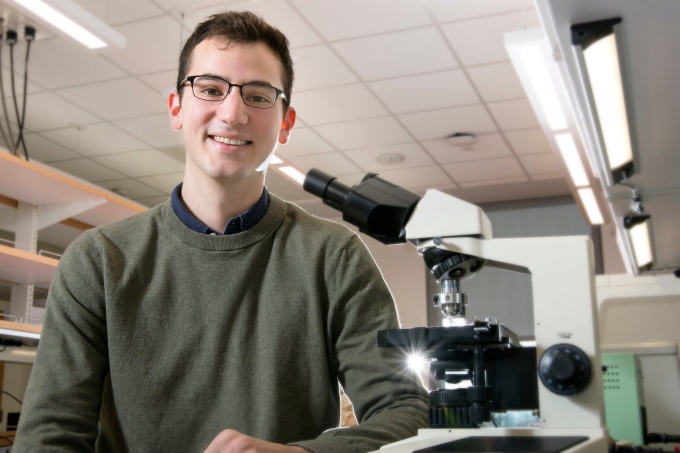
Garrett Sheehan, a doctoral candidate, examines a sample for testing.
As a pharmacology PhD candidate, you will do research in our highly collaborative environment, present your findings in a variety of settings and acquire the skills of a well-rounded, independent research scientist.
Our distinguished faculty will mentor you through the full scope of your research, from training you to use equipment and analyze data through writing grants. You will work with state-of-the-art synthetic and computational resources to develop novel molecules and study their effects in the body and the environment.
In the process, you will build interdisciplinary research skills with applications to careers in drug discovery, neuroscience, toxicology, endocrinology, public health and many other fields.
Shape Your Career
The majority of our students enter the department through the interdisciplinary PhD Program in Biomedical Sciences for the first year.
Students are fully funded through the entire course of their studies. This support allows you to completely immerse yourself in your research, giving you chances to collaborate closely with our faculty, and faculty throughout the medical school and in allied departments and institutions.
The multiple lab rotation system in the PhD Program in Biomedical Sciences gives you experience working in a wide array of research projects before you choose one for your dissertation work in the Department of Pharmacology and Toxicology.
Program Learning Outcomes (PLOs) define what students will know and be able to do because they have successfully completed the PhD program in pharmacology. Assessment is conducted on a regular basis to determine to what extent students achieve the PLOs, to guide program modifications and to improve teaching and learning practices.
- Students will demonstrate mastery of basic biomedical knowledge with an emphasis on the fundamental principles and concepts in pharmacology and toxicology.
- Students will incorporate and integrate in-depth knowledge within a specialized field of study within pharmacology and toxicology, including an understanding and appreciation of the current issues and critical questions in their research area.
- Students will develop the necessary bench skills to conduct experiments appropriate for their research area.
- Students will develop analytical skills to critique and apply scientific information, including the ability to critically read and critique research papers.
- Students will develop the ability to design, analyze, interpret and critically evaluate hypothesis-based studies to address their research questions.
- Students will become proficient in oral and written scientific communication, including the ability to organize and present their results in oral presentations, poster presentations, grant applications, manuscripts and their dissertations.
- Students will develop an understanding of the career opportunities and paths that can be achieved with a PhD in pharmacology & toxicology.
Learn More
Contact Us
For questions about admissions and academic advisement, please contact:
