Departmental Research Facilities
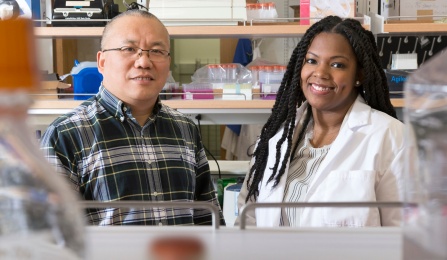
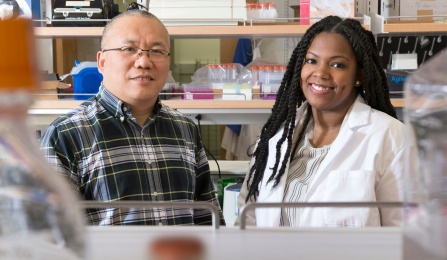
Doctoral student Lakeisha Lewter, right, has access to a range of state-of-the-art equipment and mentors such as Jun-Xu Li, MD, PhD, while conducting research.
Our department has equipment on site to carry out cutting-edge studies at the molecular, cellular, whole organ and whole system levels.
In tandem with the school’s core facilities, we offer our faculty and student investigators full support for clinical translational research toward drug discovery and improving health worldwide.
Molecular and Cellular Studies
Our faculty labs house a wide variety of equipment to measure changes in neurotransmitter receptors and signal transduction pathways:
- Leica cryostat and microtome, a high-quality apparatus for making tissue slices
- Lonza 4D-nucleofector to carry out genetic manipulation via cellular transfection and manipulate molecular pathways using RNAi technology
- BioRad Experion™ Automated Array Electrophoresis Station to rapidly separate and quantify extremely small amounts of protein, RNA and DNA
Electrophysiology
This equipment measures electrical activity in single cells and across single ion channels:
- Patch clamp and two-electrode voltage clamp system
- IONOptix System to monitor single heart cells
- Lagendorff Heart Perfusion System to monitor isolated heart functioning
Proteomics
- Prospective Biosystems-STR Mass Spectrometer
- Agilent 1200 High-Performance Liquid Chromatographer to separate proteins and molecules
- Agilent 6130 Quadrupole for multimode liquid chromatography/mass spectrometry
- Agilent 6890/5973 for gas chromatography/mass spectrometry
- molecular modeling platforms including SYBYL (at UB’s New York State Center of Excellence in Bioinformatics and Life Sciences), CHIMERA and MOE
Microscopy
We have a wide variety of microscopic platforms, including fluorescence microscopes to perform imaging at the cellular and subcellular levels.
- Olympus IX51 inverted fluorescence microscope with cooled CCD camera
- BMG Polarstar Galaxy System to assess protein-protein interactions, measuring changes in luminescence, fluorescence and fluorescent polarization in a microplate format
Behavioral Neuropharmacology
- Optogenetics laser system and equipment to monitor behavioral events in real time
- HomeCageSystem automated system for behavioral phenotyping, which can measure more than 25 distinct behaviors at once from a single subject and record data from up to 16 individual subjects
- ClockLab/Matlab Actimetrics equipment to continuously monitor the modulatory effects of drugs on circadian rhythms and behavior
- LocoSystem and Clever System apparatus for automated measurements of locomotor activity to assess behavioral sensitization and conditioned place preference
- tail flick analgesia meter
- drug self-administration chambers
Our department is licensed to obtain research material from the National Institute on Drug Abuse to support our work in this field.
Toxicology
The Toxicology Research Center, led by our faculty, supports basic and applied research on chemicals of environmental concern. One of the school’s core facilities, it offers investigators a wide variety of resources.
Equipment for Molecular and Cellular Studies
- Krumdieck precision-cut tissue slicer
- custom designed incubators
- Wallac Tri/Lux Microbeta Scintillation Chemiluminescence Counter
- microplate readers
- densitometers
Models and Cell Cultures
- in vitro models useful for comparative studies
- primary tissue explant models
- cell cultures using various cell lines
This center can conduct Single Stranded Conformation Polymorphism (SSCP) and Restriction Fragment Length Polymorphism (RFLP) analysis for studies in toxicogenomics.
It has also developed novel techniques to evaluate antimicrobial activity on a wide range of materials using a variety of test microbes and can test the effects of the agent on the function of the treated material. It also has the protocols for preclinical drug testing in support of New Drug Applications, where its primary focus has been on radiodiagnostic drugs, particularly brain imaging agents.
Cardiovascular Medicine
Working in an unparalleled environment, investigators in the Center for Research in Cardiovascular Medicine, which includes physician-scientists who mentor pharmacology graduate students, conduct a broad array of interdisciplinary research in translational cardiovascular medicine.
Located in the UB Clinical and Translational Center (CTRC), directly above the Gates Vascular Institute. This proximity allows us to conduct bench-to-bedside research within steps of the cardiovascular division’s primary site for patient care, where they pursue novel surgical therapeutics. Additionally, the apposition of medical care and research facilities allows investigators to collaborate across the translational interface.


