Collaborative Research
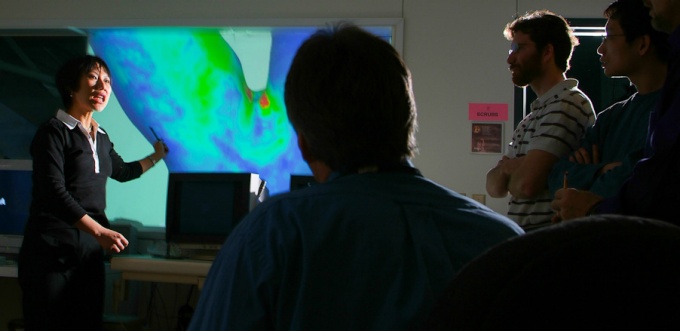

We work with faculty from all over the university, including Hui Meng, PhD, of the School of Engineering and Applied Sciences, pictured above discussing ongoing research with her lab.
Find your niche in this lively research community by joining one of our faculty labs. We collaborate widely, bringing together distinct expertise within our department and well beyond it.
Buffalo offers rich opportunities for the professional development of all researchers, especially graduate research assistants and postdoctoral associates. Along with the wealth of research instrumentation at UB’s shared facilities, our location, close to both Hauptman-Woodward Medical Research Institute and Roswell Park Comprehensive Cancer Center, offers access to research support and consultation with experts in an extraordinary variety of fields.
Collaborations Across UB
Our faculty regularly reach across disciplines for research collaborators.
Suzanne G. Laychock, PhD, collaborates with faculty from the medical school and farther afield:
- With Lucy D. Mastrandrea, MD, PhD, of the Department of Pediatrics, she studies the characterization of intracellular molecular messengers in pancreatic beta cells and the regulation of insulin secretion.
- With Stelios T. Andreadis, PhD, of the Department of Chemical and Biological Engineering, she pursues projects related to engineering skin cells to secrete insulin.
- With E. (Manolis) S. Tzanakakis, PhD, also of the Department of Chemical and Biological Engineering, she works on creating insulin-secreting pancreatic beta cells from human stem cells for use in in vitro studies and potentially to treat diabetes mellitus through transplantation.
- Laychock also studies the rat model of generational obesity and the dietary influences that program obesity early in life with Mulchand S. Patel, PhD, of the Department of Biochemistry.
Fraser J. Sim, PhD, also works with faculty within and beyond the medical school:
- He studies the induction of oligodendrocytes from human induced pluripotent stem cells for the development of novel disease models with Laura Feltri, MD, of the Department of Biochemistry and Lawrence Wrabetz, MD, of the Department of Neurology.
- With Richard J. Salvi, PhD, of the Department of Communicative Disorders and Sciences, he is studying white matter pathology following blast wave injury and induced neurogenesis in auditory centers.
- With John P. Kolega, PhD, of the Department of Pathology and Anatomical Sciences, and Hui Meng, PhD, of the Department of Mechanical and Aerospace Engineering, Sim is conducting genomic analysis of cellular response to wall shear stress.
- With Thomas R. Cimato, MD, PhD, of the Department of Medicine, Sim is working on the isolation and genomic characterization of early mesodermal/primitive streak cells derived from human pluripotent stem cells.
Collaborations Within Our Department
Our broad range of expertise permits interdisciplinary research even among our own faculty labs:
- Fraser J. Sim, PhD, and Jerome A. Roth, PhD, are studying manganese toxicity on development of human neural stem and progenitor cells.
- Margarita L. Dubocovich, PhD is working to discover molecules to act selectively on the MT1 and MT2 melatonin receptors—research that may lead to treatments for conditions such as circadian sleep disorders, jet lag, depression and cancer.